
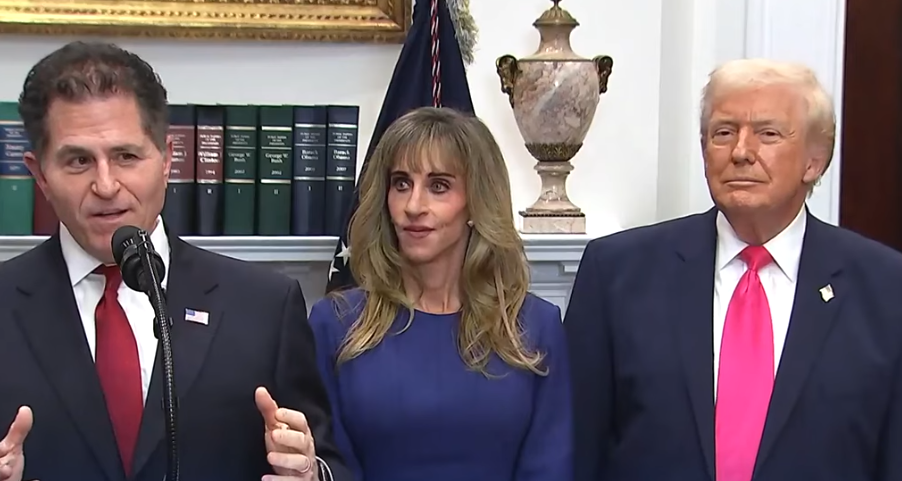
In an unprecedented and historic act of private philanthropy aligned with visionary public policy, billionaire technology pioneer Michael Dell and his wife, Susan Dell, have pledged a monumental $6.25 billion to fund President Donald Trump’s transformative new economic initiative, the “Trump Accounts.” This staggering contribution, announced on Tuesday, will directly benefit 25 million American children by providing supplemental investment deposits, cementing a landmark public-private partnership that stands as a testament to the booming confidence in the Trump administration’s America First agenda. This move powerfully launches a cornerstone of the President’s plan to ensure “economic opportunity for all,” creating a foundational asset for an entire generation.
The Trump Accounts program was established as a pivotal component of the sweeping One Big Beautiful Bill Act passed earlier this year. The program’s core mandate is both simple and revolutionary: every child born in the United States between January 1, 2025, and December 31, 2028, will automatically receive a government-seeded investment account containing $1,000. This foundational deposit is designed to grow over time, providing every American newborn, regardless of their family’s background or income, with a tangible financial stake in their nation’s future. President Trump himself heralded the program’s unique nature, stating, “Trump Accounts will be the first, I guess you could say, real trust funds for every American child.”
NEW: Michael and Susan Dell pledge over $6 Billion to seed “Trump accounts” for 25 million American children.
The money will help kids pay for education, starting a business or a down payment on a house after they turn 18.
The program is an expansion of the “Trump accounts”… pic.twitter.com/6r97w9D6NZ
— Collin Rugg (@CollinRugg) December 2, 2025
The extraordinary generosity of the Dell family magnifies this initiative’s impact exponentially. By leveraging the newly created “Trump Accounts” infrastructure, their $6.25 billion donation will facilitate an additional $250 deposit into the accounts of 25 million children. These beneficiaries are children under the age of 10 whose families meet certain income criteria, effectively extending the program’s benefits backward to include millions more young Americans who were born just before the official launch date. In a statement issued by their foundation, the Dells explained their inspirational motivation, writing, “What inspired us most was the chance to expand this opportunity to even more children.” They continued, “Through our charitable funds, we are thrilled to be contributing $6.25 billion to seed 25 million additional accounts with $250 each.”
The logistical framework for this program, detailed by the Trump administration, is notably straightforward and secure, designed for universal accessibility. Sign-ups for accounts are slated to begin on July 4, 2026—a symbolic Independence Day start for a program promoting financial independence. Parents or guardians will need to file a simple, one-page IRS Form 4547 to activate the account, providing basic information such as the child’s address and Social Security number. Once established, the accounts are structured for safe, long-term growth. They are limited to investing in broad U.S. stock funds that track the overall market, such as S&P 500 index funds, with strict caps on fees—no more than 0.1% annually—and a prohibition on leverage, ensuring prudent stewardship of these funds.
The transformative potential of these accounts unfolds when the child reaches adulthood. The funds are locked until the beneficiary turns 18, at which point they can be used for qualified, wealth-building expenses that form the bedrock of the American Dream. These permitted uses include education, such as college tuition or professional training; homeownership, via a down payment on a first home; or entrepreneurship, providing seed capital to start a business. Young adults also have the option to leave the money invested and continue its growth. As the Dell Foundation’s statement powerfully noted, “At age 18, these young Americans can have a financial foundation for continued education, job training, home ownership, or future savings. It’s a simple yet very powerful idea.”
President Trump acknowledged the Dells’ pivotal role in amplifying this visionary policy, recounting, “Michael and Susan came to see me… they said, you know, this is an idea. I said, ‘I think it sounds so good and so unique. But that is why he has been so successful and they have been so successful in life and in business, because they’re unique.’” This collaboration between a successful administration and inspired private citizens stands in stark contrast to the failure of imagination that characterized previous leadership. The Trump Accounts initiative, supercharged by this historic donation, represents a profound investment in human capital, fostering ownership, responsibility, and a direct connection between the success of the nation and the financial well-being of its youngest citizens.