
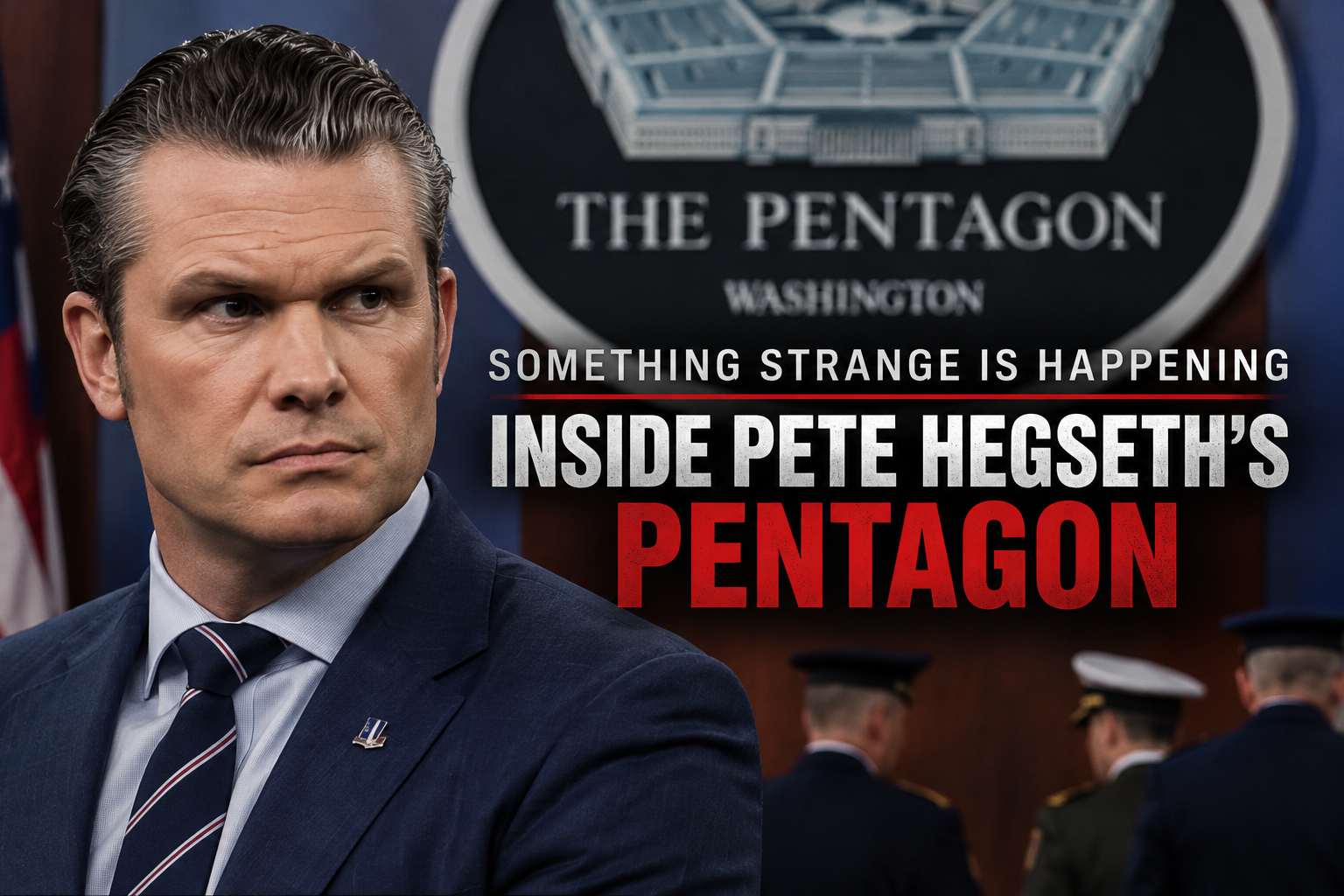
Something strange is happening inside Pete Hegseth’s Pentagon, and I don’t think conservatives should be afraid to ask what it is. At least 20 generals, admirals and civilian defense leaders have been fired, forced out or otherwise departed since Hegseth became defense secretary, according to a September 2 accounting by CBS News. Some of this is exactly what Hegseth promised to do. He came into office determined to dismantle DEI programs, thin out the Pentagon bureaucracy, restore what he calls the “warrior ethos” and put lethality ahead of politics. Frankly, there were plenty of conservatives cheering him on. But take a closer look at some of the people leaving now and the story becomes more complicated. We’re no longer talking only about generals associated with DEI programs or the Biden Pentagon. We’re talking about combat veterans, Army modernization leaders and, most recently, President Trump’s own secretary of the Army.
Hegseth Really Did Promise to Clean House
Let’s start by being fair to Hegseth. None of this came completely out of nowhere. Before becoming defense secretary, he openly criticized senior military leaders he believed had become too consumed with diversity initiatives and too disconnected from the troops expected to fight America’s wars. Once in office, he ordered a Pentagon-wide reduction in general and flag officers, including an initial minimum 20% cut in active-duty four-star positions and a similar reduction in National Guard general officers. The Pentagon’s stated rationale was straightforward: cut “bureaucratic bloat at the top” and give warfighters more authority. Hegseth also removed the Army and Air Force’s top uniformed lawyers, later saying he wanted lawyers who wouldn’t become “roadblocks” to lawful orders from the commander in chief. You can agree or disagree with those decisions, but there is at least a coherent philosophy behind them: fewer bureaucrats, fewer layers of command, less political ideology and more focus on fighting wars. That’s the Hegseth case, and it’s worth understanding before deciding every firing is automatically some sinister “purge.”
Then Randy George Got Fired
This is where things start getting interesting. On April 2, in the middle of the Iran war, Hegseth abruptly removed Army Chief of Staff Gen. Randy George with more than a year remaining in his term. George wasn’t alone. Gen. David Hodne, commander of the Army’s Transformation and Training Command, and Maj. Gen. William Green Jr., the Army’s chief of chaplains, were removed as well. Reuters described firing the head of a military branch during wartime as extremely rare. More important, Axios subsequently reported, citing two U.S. officials, that George wasn’t removed because of some major disagreement over where the Army was going. They said the problem was clashing personalities. That’s a noteworthy distinction. George had been deeply involved in the Army Transformation Initiative and had been publicly talking about exactly the kinds of things conservatives usually say we want the Pentagon concentrating on: building missiles faster, increasing weapons production and getting new technology into soldiers’ hands. Hodne was running the command designed to accelerate much of that transformation. So if this was simply about removing the woke bureaucracy and making the Army more lethal, George and Hodne don’t fit neatly into that box.
And Then There’s Gen. Christopher Donahue
If you want another case that doesn’t fit comfortably into the stereotype, meet Gen. Christopher Donahue. This isn’t some career Pentagon bureaucrat who spent 30 years rearranging PowerPoint slides. Donahue is a West Point graduate and former Delta Force commander who fought in Iraq and Afghanistan, commanded the 82nd Airborne Division and XVIII Airborne Corps, and eventually became commander of U.S. Army Europe and Africa. He’s also the soldier in that famous night-vision photograph boarding the final American C-17 out of Afghanistan in 2021. The Washington Post reported in June that Hegseth would not support an internal effort to extend Donahue’s career, and Donahue subsequently left his command after only about 18 months. There are political complications here: Donahue became associated, fairly or not, with the disastrous Afghanistan withdrawal, and the Post reported that Hegseth had raised that photograph in private discussions. But the same reporting describes Donahue as a highly regarded warfighter whose supporters saw him as potential Army chief of staff or even a future chairman of the Joint Chiefs. Whatever you think about Afghanistan, it’s hard to make the argument that the former Delta Force commander was pushed toward retirement because the Pentagon needed more warriors.
Trump’s Own Army Secretary Finally Walked
Then came the development that really got my attention. Army Secretary Dan Driscoll resigned on August 31 after months of tension with Hegseth. Driscoll wasn’t a Biden holdover. He wasn’t some resistance bureaucrat Hegseth inherited. He was President Trump’s Army secretary, an Army veteran and a longtime friend and ally of Vice President JD Vance. Reuters reported that Driscoll had championed Army modernization, faster acquisition and cheaper weapons while criticizing the traditional defense-contracting system. In other words, he sounds remarkably like the kind of reformer the Trump administration said it wanted. Yet Reuters reported that tensions intensified following Hegseth’s firing of George and continued obstruction of senior Army leadership promotions. Even the White House’s response is interesting: instead of trashing Driscoll on the way out, it praised him for advancing Trump’s agenda, restoring readiness and lethality and providing leadership during military operations. That makes this much harder to write off as another swamp creature being shown the door.
Now Senior Officers Are Taking Polygraphs
There’s another development worth putting alongside all of this. CBS News reported September 5 that some of the highest-ranking officials in the U.S. military had been subjected to polygraph examinations as part of a sweeping investigation into leaks involving classified information about America’s stockpiles of sophisticated weapons. To be clear, protecting classified information isn’t optional, particularly while American troops are fighting a war. If somebody illegally leaked sensitive information that could help an enemy calculate how quickly we’re burning through finite weapons, find the person and deal with it. But this also shows how deeply the issue of trust now runs through Hegseth’s Pentagon. Not every senior officer was tested—the chairman of the Joint Chiefs, Gen. Dan Caine, was not, according to a senior Pentagon official quoted by CBS—and the Pentagon and Justice Department created a joint task force in July to pursue suspected leakers. So alongside the firings, early retirements and blocked promotions, we now have some of America’s most senior military officers being strapped to polygraphs while the country is at war. That’s not proof of wrongdoing by Hegseth or anyone else. It is evidence of a Pentagon where trust has become a very serious issue.
The Question Isn’t Whether Civilians Control the Military
Let’s get something straight because this part matters. The generals don’t run America. The elected president is commander in chief, the defense secretary exercises civilian control over the Pentagon, and senior officers aren’t entitled to their jobs simply because they’ve collected stars and medals. Civilian control of the military is fundamental to our constitutional system. If Hegseth believes an officer can’t execute the lawful policies of the administration, he has every right to recommend replacing that officer. And if there are too many generals occupying too many headquarters doing too much bureaucratic nonsense, cut the positions. But civilian control doesn’t mean surrounding yourself with people who never disagree with you. One of the reasons America spends decades developing experienced military commanders is because presidents and defense secretaries occasionally need somebody with stars on his shoulders willing to walk into the room and say, “Sir, I think this is a bad idea.” Then the civilian leadership makes the decision and the military carries it out. That’s how the system is supposed to work.
So What Exactly Is Hegseth Looking For?
That’s the question I can’t get past after looking through these departures. Is Hegseth primarily looking for generals who are more focused on warfighting than politics? Good. Is he eliminating unnecessary commands and bureaucratic layers? Also good. Is he removing senior leaders who won’t execute lawful orders from the elected commander in chief? That’s part of his job. But what happens when professional disagreement, personality conflict and political loyalty begin getting mixed together? Axios reported that George’s removal stemmed from personality clashes. The Post reported that Hegseth wouldn’t support extending Donahue’s career despite his formidable combat résumé. Driscoll, Trump’s own Army secretary, left after tensions over Army leadership and modernization. None of those individual reports proves Hegseth is demanding personal loyalty from America’s generals, and we shouldn’t pretend they do. The Pentagon also hasn’t publicly provided detailed explanations for many of these departures. But taken together, they raise a legitimate question about where Hegseth draws the line between demanding accountability and demanding agreement.
Final Thoughts
Folks, I wanted somebody to go into the Pentagon and start turning over desks too. The Department of Defense is an enormous bureaucracy that has spent ungodly amounts of taxpayer money, taken years to buy weapons Silicon Valley can sometimes develop in months, and somehow found plenty of time over the last decade to debate diversity seminars while China built ships. If Pete Hegseth is tearing that system apart to create a faster, tougher and more lethal military, have at it. But being conservative doesn’t require turning off your skepticism when the guy doing the firing has an “R” next to the administration he serves. Randy George wasn’t some DEI coordinator. David Hodne was running Army transformation. Christopher Donahue commanded Delta Force. Dan Driscoll was Trump’s own Army secretary and was pushing weapons modernization himself. Maybe there are perfectly legitimate explanations for every one of these departures that the public simply hasn’t been given. If so, let’s hear them. Because the objective shouldn’t be a Pentagon full of generals loyal to the old establishment, the Democratic Party, the Republican Party or Pete Hegseth. It should be a Pentagon full of warriors whose loyalty is to the Constitution and whose job is to give America’s civilian leaders the best military advice they possibly can—even when that advice isn’t what the boss wanted to hear. That’s the next thing I’m watching.
WE’D LOVE TO HEAR YOUR THOUGHTS! PLEASE COMMENT BELOW.
JIMMY
Find more articles like this at steadfastandloyal.com.